Mold Testing Cost in California: Prices, Packages, Value
Expert guidance from our California remediation team — plus local crews in 50+ cities when you're ready for help.
The mold testing cost question sounds simple — until you start shopping. One California company quotes you $295 flat, another wants $499, and a third prices every sample separately until the estimate looks like a dental bill. All three might be selling roughly the same service. Testing is also the one corner of the mold industry where pricing models differ wildly, because what you're really buying isn't a swab — it's a lab report, an interpretation, and, in the best cases, a defensible document you can hand to a landlord, a buyer, or an insurance adjuster.
This guide unpacks what mold testing actually includes, what it costs in California in 2026 under both pricing models, and — just as important — the situations where testing is genuinely worth the money and the ones where it's an expensive way to learn what your nose already told you.
In this guide:
- What Mold Testing Cost Covers: The Short Answer
- What a Mold Test Actually Includes
- Flat-Rate Packages vs. Per-Sample Pricing
- When Mold Testing Is Worth the Money
- When Mold Testing Is a Waste of Money
- Pre-Purchase and Clearance Testing: Special Cases, Special Prices
- Frequently Asked Questions
- Book Mold Inspection and Testing in California
What Mold Testing Cost Covers: The Short Answer
For most California homeowners, professional mold testing lands in one of three buckets. A testing visit priced per sample typically totals $300 to $800, depending on how many samples are collected. Flat-rate packages from testing-only firms commonly run $295 to $499 for a standard home visit. And post-remediation clearance testing — the verification pass after cleanup — usually runs $300 to $600.
What moves you within those ranges is sample count, home size, and whether the price includes the inspection itself. A full professional mold inspection with moisture mapping costs $300 to $600 on its own; some companies bundle a basic inspection into their testing packages and some bill it separately, which is the single most common reason two quotes for "a mold test" differ by hundreds of dollars. Before comparing prices, confirm what each quote contains: the visit, moisture assessment, number and type of samples, lab fees, and a written report. A $295 package with two air samples and a one-page summary is not the same product as a $499 package with four samples, moisture mapping, and a room-by-room report.
It's also worth knowing what testing does not include: removal. A testing company measures and documents. If the results say you have a problem, remediation is a separate service with a separate price — in California, typically $1,500 to $6,000 for a standard job.
What a Mold Test Actually Includes
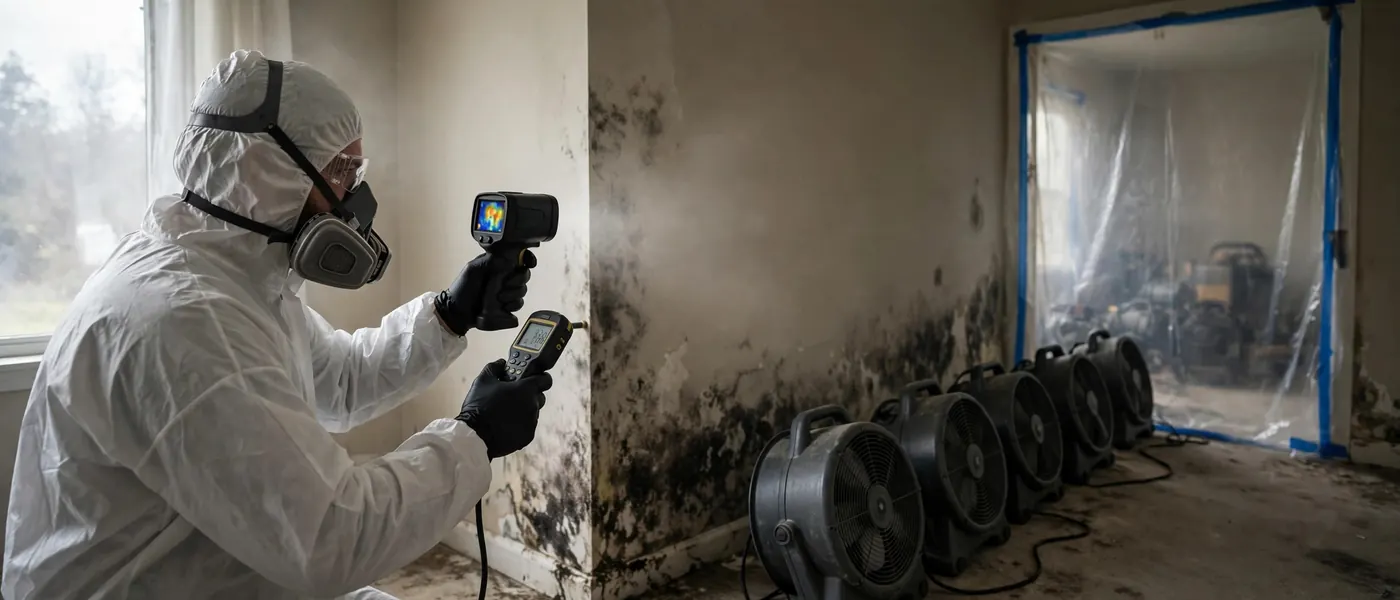
A properly run testing visit has four parts, and understanding them explains where the money goes. First, a visual assessment: the technician walks the property looking for visible growth, water stains, and likely moisture paths, usually with a moisture meter on suspicious walls. Second, sampling. Air samples are the workhorse — a calibrated pump draws a measured volume of air across a spore trap cassette, capturing airborne spores for lab analysis. A competent visit always includes an outdoor control sample, because indoor counts mean nothing without a same-day outdoor baseline. Surface samples — swabs or tape lifts from a stain or patch of growth — identify what species is growing in a specific spot.
Third, the lab. Cassettes and swabs go to an accredited analytical laboratory, where analysts identify mold genera (and sometimes species) and count concentrations. Lab turnaround is normally 2 to 5 business days, with rush fees of $25 to $75 per sample if you need results faster. Fourth, interpretation: the report compares indoor results against the outdoor control and against the rooms sampled, flags elevated or unusual species, and connects findings to probable moisture sources. That interpretation is the part you can't DIY — a cheap home kit gives you a petri dish; a professional gives you a defensible answer.
Be clear-eyed about limits, too. A test is a snapshot of one day's air. Spore levels swing with weather, HVAC use, and activity in the home, and there is no federal or California standard that declares a specific spore count "safe" or "unsafe." Good reports speak in comparisons and patterns, not pass/fail verdicts.
Flat-Rate Packages vs. Per-Sample Pricing
Testing-only firms — companies that test but don't remediate — popularized the flat package, and their menus are remarkably consistent across California. A typical entry package around $295 covers the visit, a visual assessment, and two air samples (one indoor, one outdoor control) with a standard lab report. The mid-tier package around $395 adds a second indoor air sample for a two-area home and often a surface swab. The top package around $499 usually covers a larger home: three or four air samples, one or two surface samples, moisture readings, and a fuller written report with recommendations. The appeal is certainty — you know the total before anyone arrives.
Per-sample pricing is the other model, common with inspection firms and remediation-adjacent testers. Air samples run $100 to $250 each including lab fees, surface swabs $75 to $200 each, and the visit or inspection fee ($300 to $600) may be billed on top — or waived if you proceed with remediation. This model rewards a targeted visit: if you only need one suspect room checked against an outdoor control, two samples plus a modest visit fee can undercut a package. It punishes sprawling ones: a four-room investigation at $175 a sample plus inspection gets to $1,000 quickly.
Which model serves you better depends on your goal. Buying documentation for a transaction or dispute? A flat package from an independent, testing-only firm gives you a clean, unbiased paper trail at a fixed price. Trying to locate a hidden problem? Per-sample pricing paired with a real inspection is better, because the inspector can decide on site where samples will actually answer questions instead of filling a package quota. Either way, ask two questions before booking: is the outdoor control sample included, and is the lab accredited? A package without a control sample is half a test at any price.
One structural caution: when the same company sells testing and remediation, its incentive is to find work. That doesn't make its results false, but for large jobs or contested situations, independent testing — one firm tests, another remediates — removes the conflict entirely.
When Mold Testing Is Worth the Money
Testing earns its price in specific, high-stakes situations. The first is hidden mold with no visible source: you smell it, or someone in the home has persistent symptoms, but every surface looks clean. Air sampling in the suspect room against an outdoor control can confirm whether spore levels indoors are abnormal and which species are present, pointing investigators toward the right wall or the HVAC system instead of guesswork demolition.
The second is documentation. Real estate transactions, landlord-tenant disputes, and insurance claims all turn on paper. A dated, lab-backed report showing conditions before a purchase, or proving a rental's problem exists, carries weight that photographs and opinions don't. California landlords in particular should understand that a documented complaint followed by a documented report creates a legal timeline.
The third is verification after remediation — covered in its own section below — where testing answers a yes/no question with money riding on it. And the fourth is health investigations: when a physician suspects mold exposure is contributing to a patient's condition, identifying the specific genera present (for example, distinguishing common Cladosporium from Stachybotrys or Chaetomium, which signal chronic water damage) gives that physician something concrete to work with.
When Mold Testing Is a Waste of Money
Just as clearly: if you can already see mold growing, testing usually adds nothing. State and federal health guidance are blunt on this point — visible growth should simply be removed, and the species on the lab report doesn't change how remediation is performed. The crew contains, removes, and dries the same way whether the report says Aspergillus or Penicillium. Spending $400 to be told "yes, that's mold" before spending $2,500 to remove it is $400 that bought no decision.
Testing is also a poor buy when it's sold as a scare package — a "free" or $99 test from a company that profits from the remediation it will inevitably recommend. Results in that setup tend to arrive wrapped in alarm rather than interpretation. And skip routine "annual air quality checks" for homes with no symptoms, no smell, and no water history: normal indoor air contains mold spores every day in California, and a snapshot report will almost always find something to print in bold.
The honest rule is simple. Pay for testing when a result would change what you do next — buy the house or walk, remediate this room or that one, release the contractor's final payment or hold it. If no answer changes your plan, put the money toward fixing the moisture instead.
Pre-Purchase and Clearance Testing: Special Cases, Special Prices
Two testing scenarios deserve their own pricing conversation because the stakes — and the structures — are different. Pre-purchase testing happens during a real estate inspection window, often with a deadline. Expect package pricing ($395 to $499 tiers are common) plus possible rush lab fees of $25 to $75 per sample when escrow timelines demand 24- to 48-hour results. What you're buying is leverage and certainty: a documented mold problem found before closing can be negotiated as a seller credit, a pre-closing remediation, or a price adjustment — the same problem found after closing is entirely yours. In our experience the pre-purchase test pays for itself more reliably than any other kind, especially on older California homes, homes with any history of leaks or flooding, and properties that sat vacant (vacant homes with a small leak and no ventilation are mold incubators).
Post-remediation clearance testing is the verification step after cleanup, and it's the quality-control moment for the whole project. A clearance visit — ideally performed by a tester independent of the remediation crew — combines a detailed visual inspection of the work area (looking for dust, debris, and remaining growth), moisture readings to confirm materials are dry, and air samples inside the former containment area compared against outdoors. It runs $300 to $600 in California depending on the size of the area and sample count. If results come back elevated, the remediation company returns to re-clean — which is exactly why clearance testing should be agreed upon, in writing, before remediation starts, including who pays for the retest if the first clearance fails.
Both services sit inside our mold inspection and testing services — inspection first, sampling where it answers a real question, and clearance verification when a job needs documented proof. If a company you interview resists independent clearance testing, treat that resistance as information about the company.
Frequently Asked Questions
How much does a mold test cost in California?
Most homeowners pay $295 to $499 for a flat-rate testing package, or $300 to $800 for a per-sample visit depending on sample count. Air samples run $100 to $250 each, surface swabs $75 to $200, and a standalone inspection adds $300 to $600 if billed separately.
Are DIY mold test kits worth it?
At $10 to $50 they're tempting, but the results are rarely actionable: no outdoor control, no calibrated air volume, no accredited interpretation, and petri-dish kits grow mold from any normal home's air. They can't be used in transactions or disputes. If the answer matters, test professionally.
How many samples does my home need?
At minimum two: one indoor sample from the suspect area and one outdoor control. Most standard homes need two to four total; add a sample per additional suspect room or floor. A good tester explains why each sample is being taken before collecting it.
Does insurance pay for mold testing?
Sometimes, when testing is part of documenting a covered claim — for example, after a burst pipe loss. Testing ordered on its own, without an underlying covered event, is usually an out-of-pocket expense. Your adjuster can confirm before you book.
How long do mold test results take?
Standard lab turnaround is 2 to 5 business days. Rush analysis (24 to 48 hours) is widely available for roughly $25 to $75 per sample — commonly used during real estate escrows and before clearance sign-offs.
Get Mold Remediation in Your City
Need Mold Removed Fast?
Our California crews are ready 24/7. Call now for a free assessment and an upfront flat-rate quote in writing.
Upfront flat-rate pricing • Written guarantee • 24/7 emergency service